Here is part of an interview with Shane Claiborne on community. We are looking at concepts of community here at Bethel Church over the next month. He psoes a fascinating challenge that a myopic love for our family or our nation (perhaps our church, city, friends, job as well) could cause us to lose sight of our God given call. The rest of the interview is here.
Let's talk about "doing life together." We have a nuclear vision of Christian community, where the church is divided up into families, and the families come together now and then but otherwise live their lives apart, sealed off behind the four walls of their separate homes. Does this make it more difficult to recover something resembling the community of the early church?
Without a doubt there's some deep wisdom in the scripture that says that we're not to conform to the patterns of the world but be transformed by renewing our minds. We're to have a new way of thinking about things, including family. Jesus really challenges the notions and even the idol that we have made of the nuclear family, when he says, "Unless you hate your own father and mother, you're not ready to be my disciple." I know that Jesus is not shunning a love for our family. He loved his mother, and as he was dying on the cross he encouraged John to take care of her. But he's pushing the boundaries of where our love stops.
A lot of times a love for our own family or our own nation creates a shortsightedness. This is my people and my family. But Jesus says, actually, you're born again. That means that if someone is in prison, it's like your own kids are in prison. If someone's suffering injustice, it's like you're suffering. I really love the line, "A love for our own people is not a bad thing, but our love doesn't stop at any border."
We are born again into a terribly dysfunctional family. If we're going to take our rebirth seriously, it should keep us up at night. It should allow us to be disturbed by the pain and the suffering that is happening around the world and even right next to us.
Wednesday, August 11, 2010

Tuesday, August 10, 2010
Tourists for a week - Part 3
Polignano is positioned on a steep sea cliff dotted with caves. A lot of the old town is perched quite pecariously on the cliff face with stunning views over the bautiful azure colours of the Adriatic.. It is quite spectacular.

Apperitivo - one of my favourite things about Italy. A light lunch before lunch..hmm..more food.


Polignano was the birthplace of Domenica Modugno who sang "Nel blu dipinto di blu" ("In the blue, painted blue"), also known as "Volare". You will know it when you here it.


Apperitivo - one of my favourite things about Italy. A light lunch before lunch..hmm..more food.


Polignano was the birthplace of Domenica Modugno who sang "Nel blu dipinto di blu" ("In the blue, painted blue"), also known as "Volare". You will know it when you here it.

Tuesday, June 29, 2010
Tourists for a week - Part 2
This is a bit late, but here is some tourist related activity from Steven and Bec's visit. We have Kushla and Laura with us this week so we get to be tour guides again.
Trani is a sea port of Pulgia on the Adriatic Sea, about 30 minutes north of Bari. In the middle ages it was a key port for the crusades, with many leaving for battle from there. There is still a Templar Knights Church in Trani which was the last stop for many befroe embarking on the hazardous sea journey.

Trani at sunset

Selling fresh fish

Dinner overlooking the boats

Cathedral - dedicated to St Nicholas. This is St Nicholas the Pilgrim (not Santa Claus St Nick from Bari), a Greek assassinated at Trani in 1094 and canonized by Urban II. It is in such a beautiful spot overlooking the sea.


Emperor Frederick II built a massive castle in Trani in the early 13th century which juts out onto the sea.
Trani has had a strong Jewish population. By the 12th century, Trani housed the largest Jewish community of Southern Italy. Jews were originally brought to Trani as salves during the time of the crusades and later began to thrive. Vica La Giudea (Jew Road) and others still exist in the Jewish quarter.
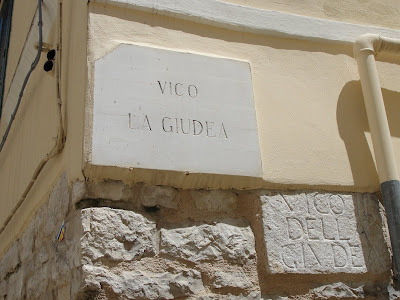
At one point there were four synangogues in Trani. The Jews were soon persecuted. The Scolanova Synagogue survives and, after many centuries as a church, has been rededicated as a synagogue.

On the sign outside the synagogue it mentions in Italian that the it was transformed into a church towards the end of 1400. In the English version it adds "(after the fall of the Jewish community)" which is no doubt a euphemism in itself. The road the synagogue is now called Via Scolanova but the old name which is still visible was Strada Stregatezze - Witchery Rd, which probably highlights the local attitude towards the Jews in those days.

By 1380 all of the four synagogues in Trani had been converted to churches and the 310 Jews remaining in the city forcibly converted to Christianity. The talmudist Rabbi Moses ben Joseph di Trani (1505–1585) was born in Thessaloniki, three years after his family had fled there from Trani due to antisemitic persecution.
The church of Sant'Anna is another medieval former synagogue which now houses artifacts from the Jewish history of the area.
Trani is a sea port of Pulgia on the Adriatic Sea, about 30 minutes north of Bari. In the middle ages it was a key port for the crusades, with many leaving for battle from there. There is still a Templar Knights Church in Trani which was the last stop for many befroe embarking on the hazardous sea journey.

Trani at sunset

Selling fresh fish

Dinner overlooking the boats

Cathedral - dedicated to St Nicholas. This is St Nicholas the Pilgrim (not Santa Claus St Nick from Bari), a Greek assassinated at Trani in 1094 and canonized by Urban II. It is in such a beautiful spot overlooking the sea.


Emperor Frederick II built a massive castle in Trani in the early 13th century which juts out onto the sea.
Trani has had a strong Jewish population. By the 12th century, Trani housed the largest Jewish community of Southern Italy. Jews were originally brought to Trani as salves during the time of the crusades and later began to thrive. Vica La Giudea (Jew Road) and others still exist in the Jewish quarter.

At one point there were four synangogues in Trani. The Jews were soon persecuted. The Scolanova Synagogue survives and, after many centuries as a church, has been rededicated as a synagogue.

On the sign outside the synagogue it mentions in Italian that the it was transformed into a church towards the end of 1400. In the English version it adds "(after the fall of the Jewish community)" which is no doubt a euphemism in itself. The road the synagogue is now called Via Scolanova but the old name which is still visible was Strada Stregatezze - Witchery Rd, which probably highlights the local attitude towards the Jews in those days.

By 1380 all of the four synagogues in Trani had been converted to churches and the 310 Jews remaining in the city forcibly converted to Christianity. The talmudist Rabbi Moses ben Joseph di Trani (1505–1585) was born in Thessaloniki, three years after his family had fled there from Trani due to antisemitic persecution.
The church of Sant'Anna is another medieval former synagogue which now houses artifacts from the Jewish history of the area.
Saturday, June 12, 2010
Tourists for a week - Part 1
Our friends, Steve and Becs, from New Zealand came to stay with us for a week.
It was great having them here with us and to be their tour guides.
We showed them around the old part of Bari, went to Trani, Polignano, Ostuni, Alberobello, and Castellana. So here is our best impresson of being tour guides.
Firstly Old Bari, Bari Vecchia.
Rebekah & Andrea - waterfront Bari

In the Old City

St Nicolas' Basilica

Inside the Basilica

Friday, June 11, 2010
Suffering for Jesus
Italians, particularly in Southern Italy are big on hospitality. (Actually, as a side note, the idea of hospitality as Christian ministry is something we may have a lost a little bit. I have been doing a bit of thinking on this lately).
Italian Churches like to treat their guests to a good meal featuring local specialties.
Here was our meal with some of the leadership team at Bethel:
Course 1

Course 2

Course 3

Course 4

Course 5

Course 6

Course 7

Course 8

Course 9

Sorbet

Desert

Coffee

Local Wine


Italian Churches like to treat their guests to a good meal featuring local specialties.
Here was our meal with some of the leadership team at Bethel:
Course 1

Course 2

Course 3

Course 4

Course 5

Course 6

Course 7

Course 8

Course 9
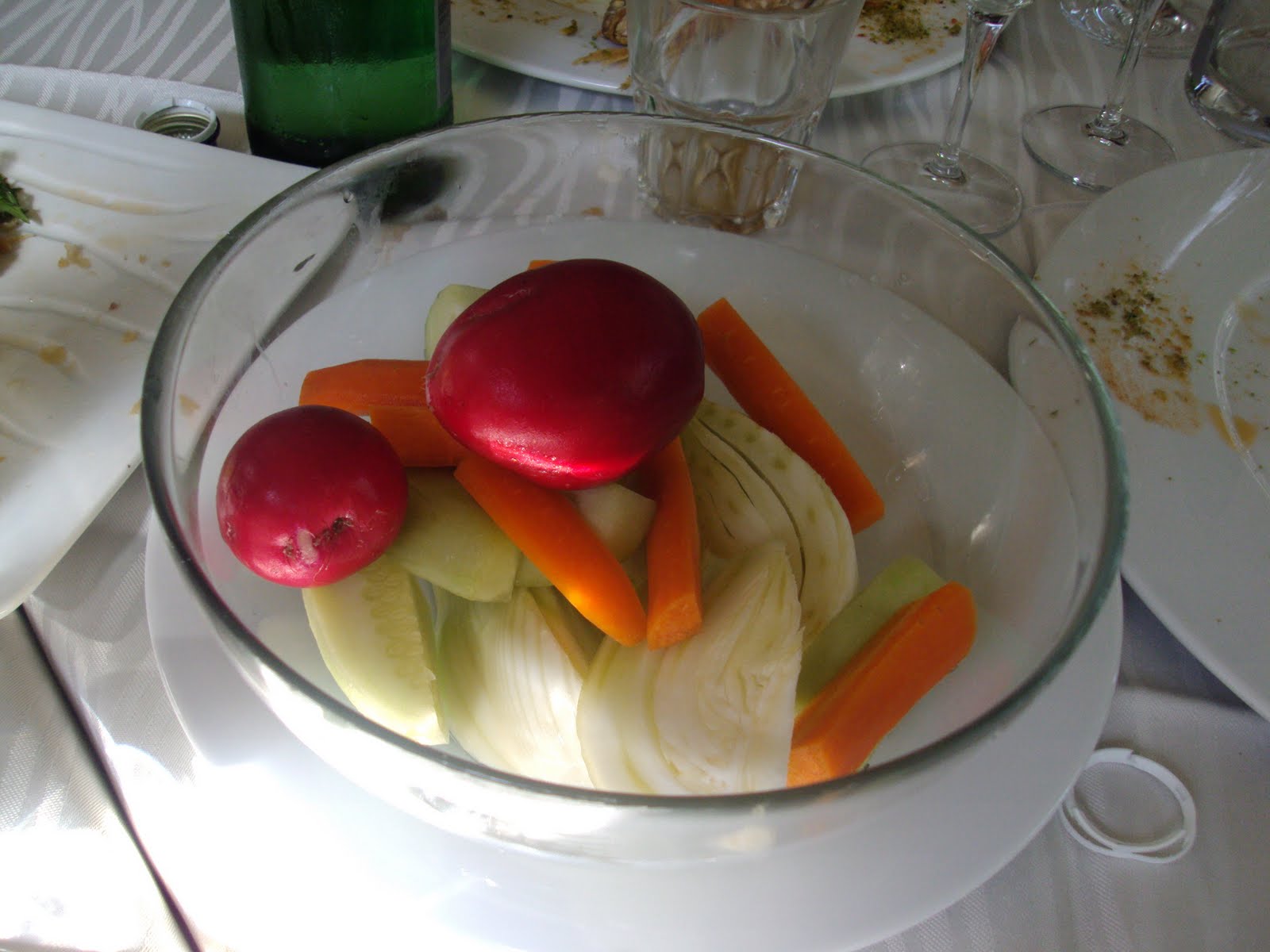
Sorbet

Desert

Coffee

Local Wine


Thursday, June 10, 2010
Visit by Ken and Mark
We had a great week with Pastor Ken and Mark Hutchinson. Ministry included:
Alphacrucis block course on Leadership
Sunday Ministry (Ken at Bari, Mark at Carato and Andria)
Leadership training with the Leaders from Bethel Church
Strategy Development meeting with the Leaders of the movement.
It was a really fruitful time and Andrea and I were really encouraged to have them her. Kaira loved it too as she kept getting spoiled!

Pastor ken ministering at Bethel Church on Sunday

Bethel Leaders

At Alphacrucis block course

At Polignano. In the background is where the cliff diving event takes place.

This is a Knights Templar Church in Trani. It was were a lot of the crusaders stopped before heading off towards Israel.
Tomorrow's post will show you the suffering we go through as missionaries in Italy!
Wednesday, June 9, 2010

Subscribe to:
Posts (Atom)