Tuesday, August 17, 2010

Hospitality Part 1

One of the things that I love about living in Southern Italy is the hospitality. When invited out for lunch it is impossible to eat and drink everything that is presented to you. As a guest they honour you and give you their best. I have really enjoyed watching the way the Italians welcome guests.

There is a depth in this hospitality that is prevalent in the middle east as well that is perhaps missing from New Zealand and other western countries. Over the next few days I want to explore the idea of hospitality and the sense in which it should be central to daily faith.

In the contemporary West, hospitality usually associated with etiquette and entertainment. In the past, especially for the ancient Greeks and Romans, hospitality was a divine right. The host was expected to make sure the needs of his or her guests were seen to. Wikipedia mentions that the ancient Greek term xenia, expressed this ritualized guest-friendship relation and adds a further term theoxenia when a god was involved (1). I wonder whether theoxenia is an appropriate term for when we offer hospitality. In engaging in hospitality perhaps we bring God into the situation. Can the act of hospitality actually amount to perhaps a supernatural act that brings the presence of God into our everyday lives?

Jason Foster suggests that Christian hospitality, as given to us in the Bible, is a sacred process of 'receiving' outsiders and changing them from strangers to guests. (2) In this sacred process Christ is present.


1. http://en.wikipedia.org/wiki/Hospitality
2. Jason Foster, Christian Hospitality: A Way of Life. Online at http://faithepchurch.org/files/Documents/Discipleship%20Resources/Hospitality.pdf accessed August 2010, 1.

Monday, August 16, 2010

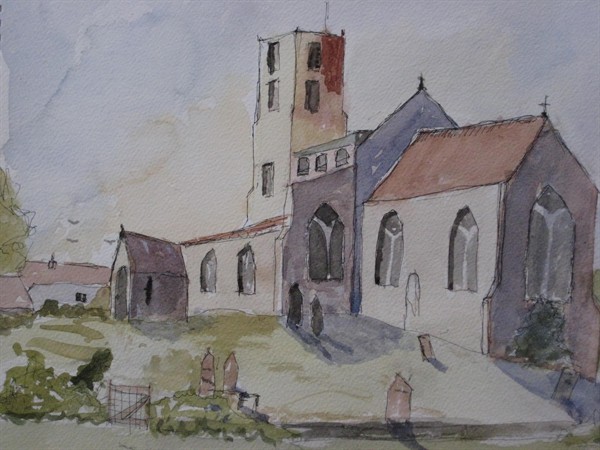
Kieron Williamson, Painting Prodigy


I love this story in the NZ Herald article on Kieron Williamson, an 8 year painting prodigy.


He's Britain's most talked-about young artist. His paintings fetch hefty sums and there's a long waiting list for his eagerly anticipated new works.

It has all happened so quickly - he's still getting used to the spotlight - and Kieron Williamson fidgets a little when he's asked to share his thoughts on art.

"Cows are the easiest thing to paint," said Kieron, who has just turned 8. "You don't have to worry about doing so much detail."

Horses, he says, are "a lot harder. You have to get their legs right, and you have to make their back legs much bigger than their front."

Paintbrush prodigy Kieron - dubbed "mini Monet" by the British press - is a global sensation. All 33 of the pastels, watercolors and oil paintings in his latest exhibition sold, within half an hour, for a total of 150,000 pounds (NZD$330,000). Buyers from as far away as the United States lined up overnight outside the gallery, and there is a 3,000-strong waiting list for his Impressionistic landscapes of boat-dotted estuaries, snowy fields and wide marshland skies.


Here is his website. I think I will buy Kaira some paitbrushes this week.


Saturday, August 14, 2010

Future Trends in Evangelicalism

Ed Stetzer makes some interesting points about the future of evangelicalism. These are two of his thoughts that I think are really pertinent to the church today:

First, evangelicals must learn to navigate what I call a "post-seeker context." When I use this term, I do not mean that seekers no longer exist. Rather, churches that once targeted seekers from the Boomer generation are finding that large portions of subsequent generations do not have the same religious memory. "Seeker churches" thrived when they could create new expressions of church that related to a population with at least some Christian memory.

I believe that all seeking is in response to the work of the Holy Spirit. In practical means, then, I believe the Spirit often uses the religious memory latent within a culture to pique the interest of the unchurched. For evangelicals to reach seekers in the decade ahead, they will need to develop new models and other means of communication to deliver our message into the cultural destination of an increasingly post-seeker context. When religious memory is gone, we can no longer rely on those outside of the faith to be interested in what it means to be inside of the faith.

Fourth, evangelicals must address our shallow definition of discipleship. LifeWay Research published a book called The Shape of Faith to Come by Brad Waggoner. Based on a study of 2,500 regular Protestant church-goers, we found the statistics revealing. Only 16 percent of participants said that they read their Bible daily, and another 20 percent said they read the Bible a few times a week. Only 23 percent agreed strongly with the statement, "When I come to realize that an aspect of my life is not right in God's eyes, I make necessary changes." In the past six months, only 29 percent said that they had shared with someone how to become a Christian twice or more, and 57 percent said they had not done so at all.

Perhaps most disappointing, however, was what had happened when they were srveyed again a year later. There was very little change in the actual data, but over 55 percent indicated that they had grown spiritually in the past year. The area of discipleship is definitely the elephant in the room for evangelicals and must be addressed going forward. Beliefs must become practice in order for evangelicalism to thrive in future decades.

Friday, August 13, 2010

Tourists for a week - Part 5

Alberobello is famous for its beautifully kept trulli. A trullo (plural, trulli) is a traditional stone dwelling with a conical roof. The style of construction is specific to Itria Valley. There are plenty all around the area but Alberbello provides a concentration of fully restored ones housing shops offering a lot of local delicacies. There are some that also offer a hotel room.


Traditionally they were built without any cement or mortar, probably to avoid taxation.


At the top of a trullo's cone there is normally a pinnacle, that may be one of many designs, chosen for symbolism. there are often symbols painted on it as well such as planetary symbols, the malocchio (evil eye), the cross, a heart, a star and crescent, or a few others.
33

Thursday, August 12, 2010

Tourists for a week - Part 4

Ostuni, about 1 hour from Bari, is also know as the "white city" because all of the buildings within its fortified walls are painted white giving it a classic Greek island feel. Standing on top of a hill the town is prominant from miles away and has commanding views over the sea about 12 kilometres away.


The region around Ostuni has been inhabited since the Stone age. The town is reputed to have been originally established by the Messapii, a pre-classic tribe, and destroyed by Hannibal during the Punic Wars. It was then re-built by the Greeks, the name Ostuni deriving from the Greek Astu néon ("new town").

Ostuni was acked after the fall of the Western Roman Empire, in 996 AD the town became part of the Norman County of Lecce.

In 1539 the town had towers built along all the shoreline, as protection against anticipated attacks from the Turks who controlled the Balkans. These towers (still existing, including Pozzella Tower, the Pylon, Villanova and others), were permanently garrisoned and communicated through fire beacons.

Main Road


City Wall


The region is well know for its olive oil which is quite outstanding. We purchased a bottle but it only lasted a week. So good for slalds and bread.

Wednesday, August 11, 2010

Community: Blinded by love

Here is part of an interview with Shane Claiborne on community. We are looking at concepts of community here at Bethel Church over the next month. He psoes a fascinating challenge that a myopic love for our family or our nation (perhaps our church, city, friends, job as well) could cause us to lose sight of our God given call. The rest of the interview is here.

Let's talk about "doing life together." We have a nuclear vision of Christian community, where the church is divided up into families, and the families come together now and then but otherwise live their lives apart, sealed off behind the four walls of their separate homes. Does this make it more difficult to recover something resembling the community of the early church?

Without a doubt there's some deep wisdom in the scripture that says that we're not to conform to the patterns of the world but be transformed by renewing our minds. We're to have a new way of thinking about things, including family. Jesus really challenges the notions and even the idol that we have made of the nuclear family, when he says, "Unless you hate your own father and mother, you're not ready to be my disciple." I know that Jesus is not shunning a love for our family. He loved his mother, and as he was dying on the cross he encouraged John to take care of her. But he's pushing the boundaries of where our love stops.

A lot of times a love for our own family or our own nation creates a shortsightedness. This is my people and my family. But Jesus says, actually, you're born again. That means that if someone is in prison, it's like your own kids are in prison. If someone's suffering injustice, it's like you're suffering. I really love the line, "A love for our own people is not a bad thing, but our love doesn't stop at any border."

We are born again into a terribly dysfunctional family. If we're going to take our rebirth seriously, it should keep us up at night. It should allow us to be disturbed by the pain and the suffering that is happening around the world and even right next to us.

Tuesday, August 10, 2010

Tourists for a week - Part 3

Polignano is positioned on a steep sea cliff dotted with caves. A lot of the old town is perched quite pecariously on the cliff face with stunning views over the bautiful azure colours of the Adriatic.. It is quite spectacular.


Apperitivo - one of my favourite things about Italy. A light lunch before lunch..hmm..more food.


Polignano was the birthplace of Domenica Modugno who sang "Nel blu dipinto di blu" ("In the blue, painted blue"), also known as "Volare". You will know it when you here it.